- Home
- Nachrichten
- One of the special relics of Hungarian monetary history
One of the special relics of Hungarian monetary history
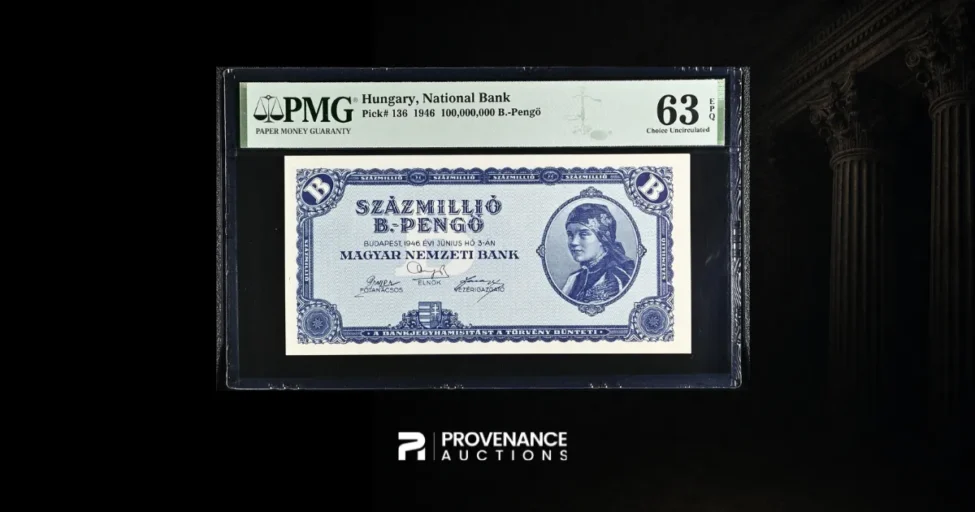
At first glance, an old banknote may seem like nothing more than a beautifully printed piece of paper. A denomination, a date, a few decorative elements, signatures, a portrait or an architectural image. In the world of numismatics, however, these details mean much more.
A banknote was not only a means of payment. It can also tell the story of a specific era’s economic conditions, social changes, historical turning points and visual culture.
This is especially true of pieces connected to extraordinary historical periods — such as the years of Hungarian hyperinflation.
A banknote that evokes an era
The 1946 100 million B-pengő banknote is one of the special relics of Hungarian monetary history. In post-Second World War Hungary, the value of the pengő declined at a dramatic pace, while denominations became increasingly larger.
During this period, the B-pengő appeared, referring to the abbreviation of “billion pengő”. For this reason, the denomination shown on the banknote may be misleading at first: 100 million B-pengő in fact represents 100 quintillion pengő.
This is not merely a large number. It is the imprint of a historical situation in which the value of money changed almost from day to day, and everyday life was shaped by highly unusual financial circumstances.
What makes an old banknote historically valuable?
The value of an old banknote is not determined solely by its face value or material. For collectors, its historical background, condition, rarity, circumstances of issue and the period to which it belongs are just as important.
A hyperinflation banknote, for example, is fascinating because it was not only a means of payment, but also a tangible document of an economic crisis. It shows how extreme the situation of a monetary system can become, and how a country attempted to adapt to rapidly changing circumstances.
From this perspective, a banknote can also be a genuine historical source.
The details tell a story too
The graphic design of banknotes also reveals a great deal about the period in which they were created. Portraits, coats of arms, architectural images, ornamental motifs and printing details all contribute to making a banknote not only a financial object, but also a visual historical relic.
On the 100 million B-pengő banknote, for example, the female portrait, the inscriptions of the Hungarian National Bank and the Budapest Parliament shown on the reverse are all elements strongly connected to Hungary’s historical and cultural context.
This is what makes the piece more than a high-denomination banknote: it carries the atmosphere, uncertainty and uniqueness of an entire era.
Why is condition important?
When it comes to old banknotes, condition is especially important. An uncirculated, high-grade piece that has not been used in circulation can represent an entirely different collecting category from a heavily used example.
Good condition preserves the details of the printing, the freshness of the paper and the original character of the banknote. This is why rarer or historically interesting banknotes can be particularly sought after in high grade.
In the case of a PMG-certified banknote, condition and authenticity become easier for collectors to interpret, which can be especially important for more valuable pieces.
A piece of history in a collection
Collecting old banknotes is not only a matter of aesthetics or investment. It is often a personal connection to the past. Holding such a piece in your hand offers a very different experience from reading about a historical period in a book or on a screen.
A banknote can survive decades, political systems, economic crises and family stories. By the time it enters a collection, it already carries a past of its own.
For this reason, old banknotes are not only worth owning, but also preserving, appreciating and passing on.
Special banknotes and coins in the webshop
The true value of numismatic pieces often lies in their story. A rare coin or banknote is not only a collector’s item, but a tangible connection to an earlier world.
In the Provenance Auctions webshop, special coins and banknotes are available for those who wish not only to collect, but also to hold history in their hands.
Haben Sie eine Münze, Banknote oder Sammlung zu Hause?
Sie müssen den Wert nicht im Voraus kennen.
Artikel teilen
Neueste Nachrichten
Folgen Sie uns!
Haben Sie Fragen?
Wir helfen Ihnen gerne.
Wenn Sie eine Frage zu einer Auktion haben oder Unterstützung bei einer unserer Dienstleistungen benötigen, kontaktieren Sie uns bitte. Füllen Sie das Formular aus, und wir werden uns so schnell wie möglich bei Ihnen melden. Wir stehen Ihnen in jeder Phase des Bietprozesses sowie bei allen damit verbundenen Anliegen zur Verfügung.