What to look for on an auction lot page?
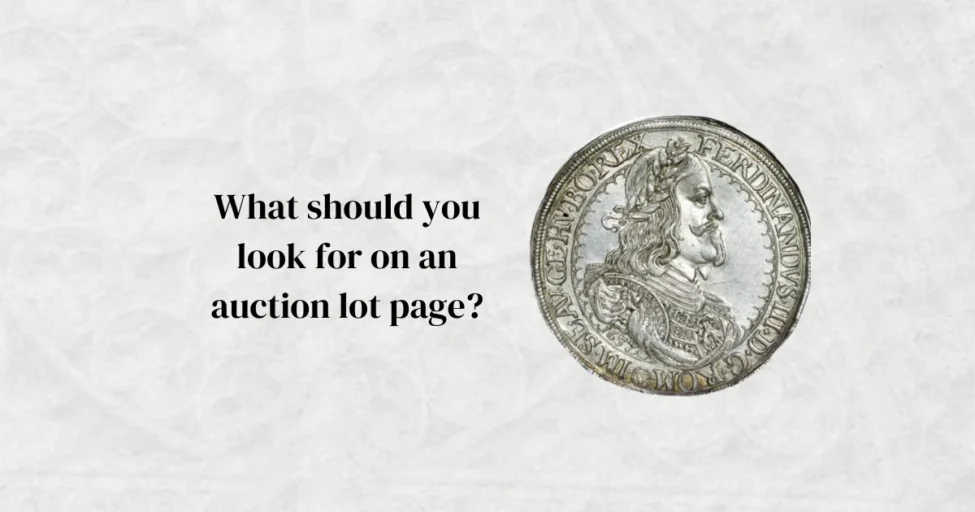
A photograph of an auction lot can reveal a great deal about a coin, but on its own it does not provide the full picture. To make a well-informed decision, it is worth reviewing all the key information on the lot page, as the date, mint, type, condition, grade and provenance can all influence how the rarity, desirability and market value of a coin should be assessed.
Two coins that look almost identical at first glance can differ significantly. A scarcer variety, an unusual mintmark, exceptional preservation or a documented collection history may all be important details that are not immediately obvious from the image alone. This is why, at auction, it is worth examining not only the coin itself but also the professional information provided with it.
Date, mint and type: why small differences matter
The date is usually one of the first details we look at on a coin, but on its own it does not necessarily tell us much about rarity. The same coin type may have been struck over several years, at different mints, and sometimes in several varieties. Some of these may be common, while others can be distinctly rare. A particular date or mint may have had a much smaller mintage, or far fewer examples may have survived to the present day. Mintmarks, small differences in legends and other details can therefore carry considerable numismatic significance.
Accurate identification of the type and variety is also important because collector demand is not distributed evenly across all examples. Two coins that appear nearly identical may differ considerably in availability: one may be easy to find on the market, while the other may appear only rarely at auction. This can naturally be reflected in their value as well. A detailed lot description therefore does more than list technical information: it helps identify exactly which variety is being offered and how it fits within the wider type.
Condition and grade: when preservation is rarer than the coin itself
Condition is one of the most important factors in assessing a numismatic item. A coin may be a rare type, but heavy wear, damage or improper past treatment can significantly affect both demand and value. At the same time, a relatively common coin can itself become exceptional if it survives in unusually high condition. For this reason, the numismatic market considers not only how many examples of a particular type are known, but also how many have survived in a comparable state of preservation.
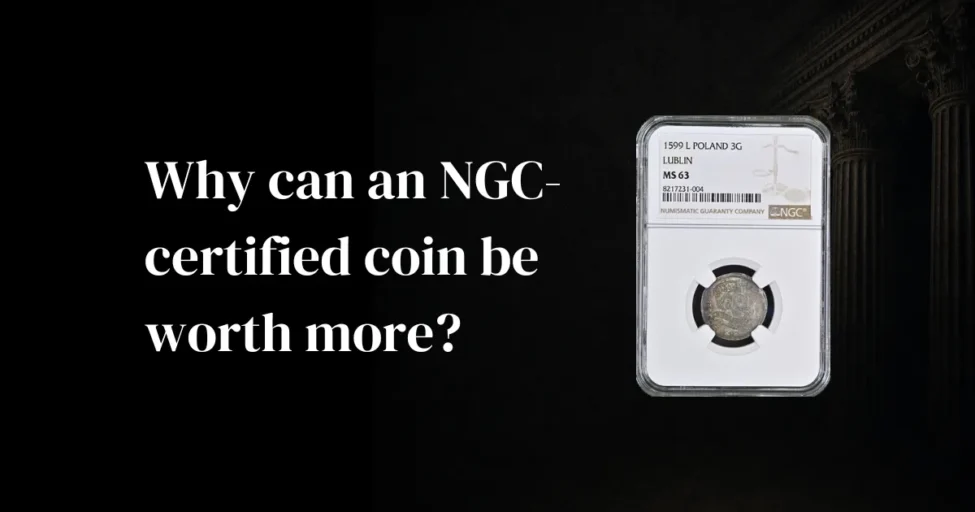
For certified coins, the grade provides a standardized assessment of condition and makes it easier to compare individual examples. In today’s collector market, condition can in many cases carry at least as much weight as, and sometimes even more than, the rarity of a particular type or mint. It is not unusual for a common type in outstanding condition to achieve a higher price than a much rarer coin in a lower grade. The reason is that while the type itself may be readily available, examples surviving in that particular grade can be extremely scarce. A grade should therefore always be interpreted in the context of the specific coin type, date and known surviving examples.
Provenance and previous auction results
Provenance refers to the documented history of a coin. This may include the collections it previously belonged to, earlier auctions in which it appeared, or other ownership and market records associated with it. A well-documented history can provide important context for a lot and, in some cases, significantly enhance both its collector appeal and its value. Provenance can be especially meaningful when a coin comes from a notable collection or when its history can be traced back over a long period of time.
Previous auction results can also provide useful reference points. They may show the prices achieved by identical or comparable examples of the same type, date and condition, although such results should always be interpreted with care. Condition, provenance, the circumstances of a particular auction and current demand can all influence the final price. Previous results therefore do not necessarily determine what a lot will achieve in the future, but they can provide valuable market context for comparison.
An auction lot page is therefore much more than a simple technical description. The date, mint, type, condition, grade, provenance and previous auction results together help explain exactly what is being offered. Before bidding, it is worth reviewing not only the photographs but also the full lot description carefully.
Do you have a coin, banknote or collection at home?
You don’t need to know its value in advance.
Share article
Latest News
Follow us!

Do you have questions?
We are here to help.
If you have a question regarding an auction or require assistance with any of our services, please contact us. Complete the form and we will respond as soon as possible. We are available to support you at any stage of the bidding process or with any related inquiry.